
Science & Technology
One distant galaxy appears twice in Hubble’s new gravitational-lens view.
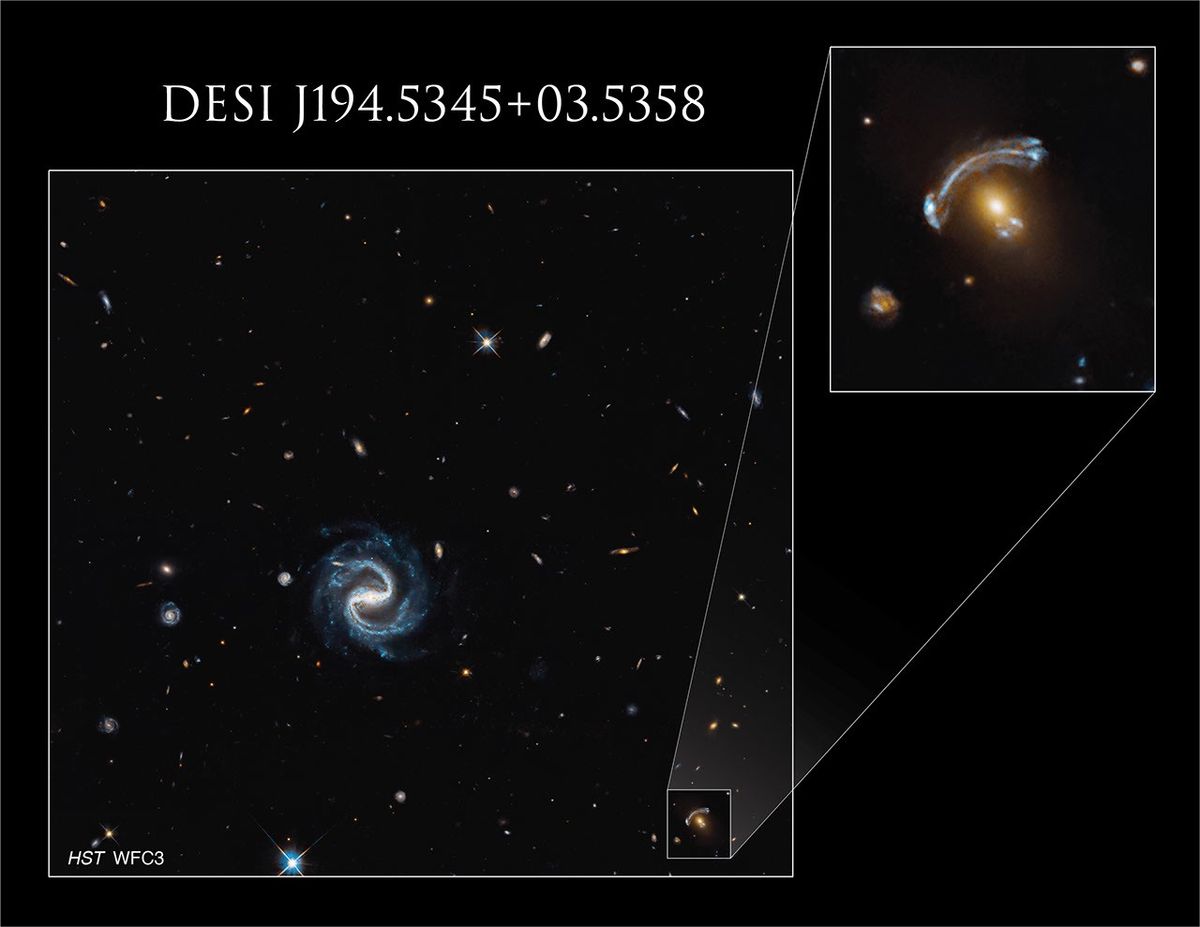
The large spiral galaxy catches the eye first. But in the lower-right corner of this Hubble view, a smaller arrangement of light is doing something stranger: showing the same distant galaxy twice.
A foreground elliptical galaxy, about 4.5 billion light-years away, is bending light from a background galaxy roughly eight billion light-years away. The farther galaxy appears as a prominent blue arc and a smaller, reversed arc on the opposite side. They are different images of one object, produced by the alignment of the galaxies and the gravity between them.
This is gravitational lensing. A massive object changes the shape of spacetime, so light passing it follows a curved path. Depending on the arrangement, that can magnify a distant object, stretch its image or create multiple apparent copies. It is the universe supplying a lens rather than astronomers building one.
The effect is useful precisely because it distorts the view. Researchers can work backward from the bending of the light to estimate how much mass lies in the foreground galaxy. Its visible stars do not account for all that mass; lensing helps investigate the unseen contribution attributed to dark matter.
Hubble’s sharp images also provide groundwork for the Roman telescope’s broader surveys. Astronomers are building models to analyze the distortions in larger fields of view. The picture does not settle what dark matter is, but it gives researchers both a remarkable sight and a measurable clue.