
The Discovery File
Hubble assembled nine cosmic lenses for Roman to investigate next
Nine strong gravitational lenses show arcs, rings and duplicated galaxies that can help map dark matter and guide Roman follow-up.
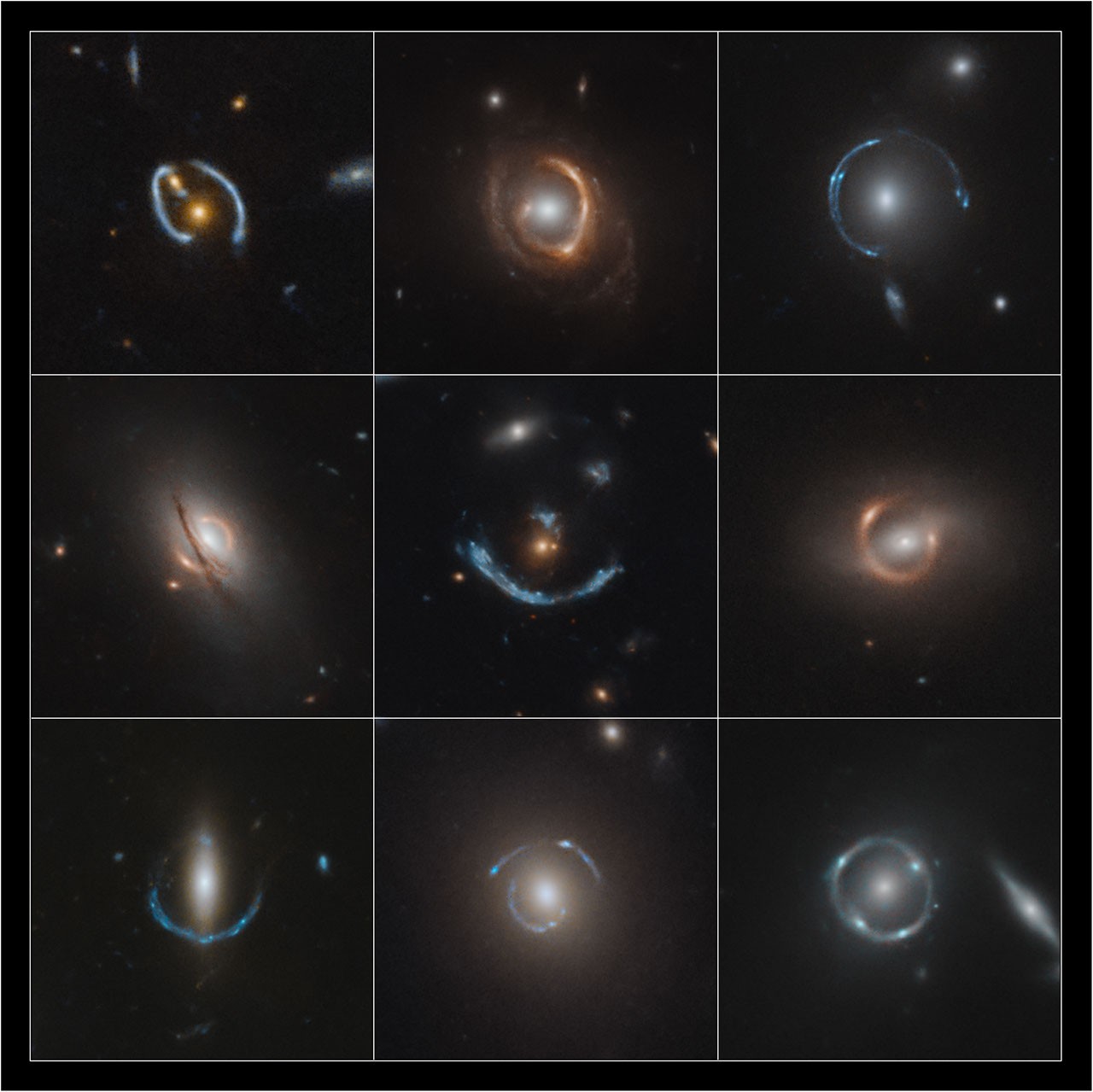
Gravity has turned nine galaxies into cosmic glassware. In a new Hubble gallery, foreground galaxies bend and magnify light from more distant galaxies, producing blue and orange arcs, near-complete rings and repeated points around bright centers.
The systems were first detected with the Dark Energy Spectroscopic Instrument and then imaged sharply by Hubble. Astronomers will use the distortions to model how much visible and invisible mass sits in each foreground galaxy. NASA’s Roman Space Telescope, launched in August, can survey a much wider field in infrared light; Hubble can then return to especially interesting targets with higher-resolution visible and ultraviolet views.
The collage is not a picture of dark matter itself. Researchers hope small imperfections in the arcs will reveal clumps predicted by cold-dark-matter theory, but that test still lies ahead. For now the Discovery File contains nine real optical tricks and one elegant partnership: one telescope scouts wide, another looks close, and gravity supplies the lenses.